Blogs
How to Set a Realistic Drink Limit (and Actually Stick to It)

Most people set their drink limit the same way they set a New Year's resolution: pick an impressive number on a Sunday night, feel good about it for four days, then quietly stop counting. The number wasn't wrong because you lacked discipline. It was wrong because you picked it out of the air. A drink tracker can't fix that. An alcohol tracker will hold you to whatever number you choose, which is exactly why the number matters more than the app does.
Here's how to land on a limit that survives contact with a real week, and how to hold it once you have it.
Why Most Drink Limits Collapse by Week Two
There are two failure modes, and almost everyone hits one of them.
The first is setting the limit for a life you don't have. You're drinking around fourteen a week, you decide four sounds respectable, and you've now built a plan that requires you to be a different person starting Monday. Week one runs on novelty. Week two runs on effort. Week three there's a work dinner and the whole thing quietly ends.
The second is setting a limit without knowing your starting point. If you don't know what you're currently drinking, any number you pick is a guess dressed up as a decision. And guesses run low, because nobody remembers the fourth drink.
Start With Your Real Number, Not Your Goal
Two Weeks of Honest Logging First
Before you set any limit at all, spend two weeks doing nothing but logging. Don't change your drinking. Don't tidy the numbers up. Just log a drink every time you have one, including the ones you'd rather not count, and let the tracker collect an honest baseline.
This step gets skipped constantly and it's the one that makes everything else work. Two weeks gives you an average, a sense of which days are heavy, and usually one genuine surprise. People routinely find their real number is thirty to fifty percent higher than their estimate — not because they were lying to themselves, but because drinks blur and memory rounds down.
You can't cut back from a number you don't know. If you want the full picture of what an alcohol tracker actually does with those two weeks, that's worth reading first.
How to Set a Realistic Drink Limit
Now you have a baseline. Three steps from here.
Cut the Baseline, Don't Guess at It
Take your two-week average and cut it by roughly a third. Fifteen a week becomes ten. Twelve becomes eight. Six becomes four.
That fraction isn't science and we won't pretend otherwise — it's a rule of thumb. But it's a good one, because it's large enough that you'll notice the difference in your sleep and your mornings, and small enough that you won't spend every evening fighting yourself. A third is a change you can feel and still keep.
For a reference point rather than a rule: the US Dietary Guidelines put moderate drinking at two drinks a day or less for men and one or less for women. That's a public health benchmark, not a target we're handing you. Your limit is yours. But if your baseline is well above that, it tells you which direction there's room to move in.
Decide Where the Drinks Go
A weekly number on its own is too abstract to act on. Ten drinks a week means nothing at 7pm on a Tuesday. Ten drinks a week, none Monday through Thursday, is a decision you can actually make.
So spend the limit in advance. Look at your baseline and see where the drinks cluster, then decide which nights are alcohol-free days and which ones aren't. Most people find their weeknight drinking is the easiest to cut, because it's the most automatic and the least enjoyed — it's habit rather than occasion. Protect the Friday dinner you actually look forward to. Cut the Wednesday glass you have because the day ended.
Write Down Your Why
Write one sentence about why you're doing this and keep it where you'll see it. Not a vague one. “I want to be healthier” evaporates on contact with a bad Tuesday. “I want to stop losing Saturday mornings” holds up, because it names something specific you're trading for.
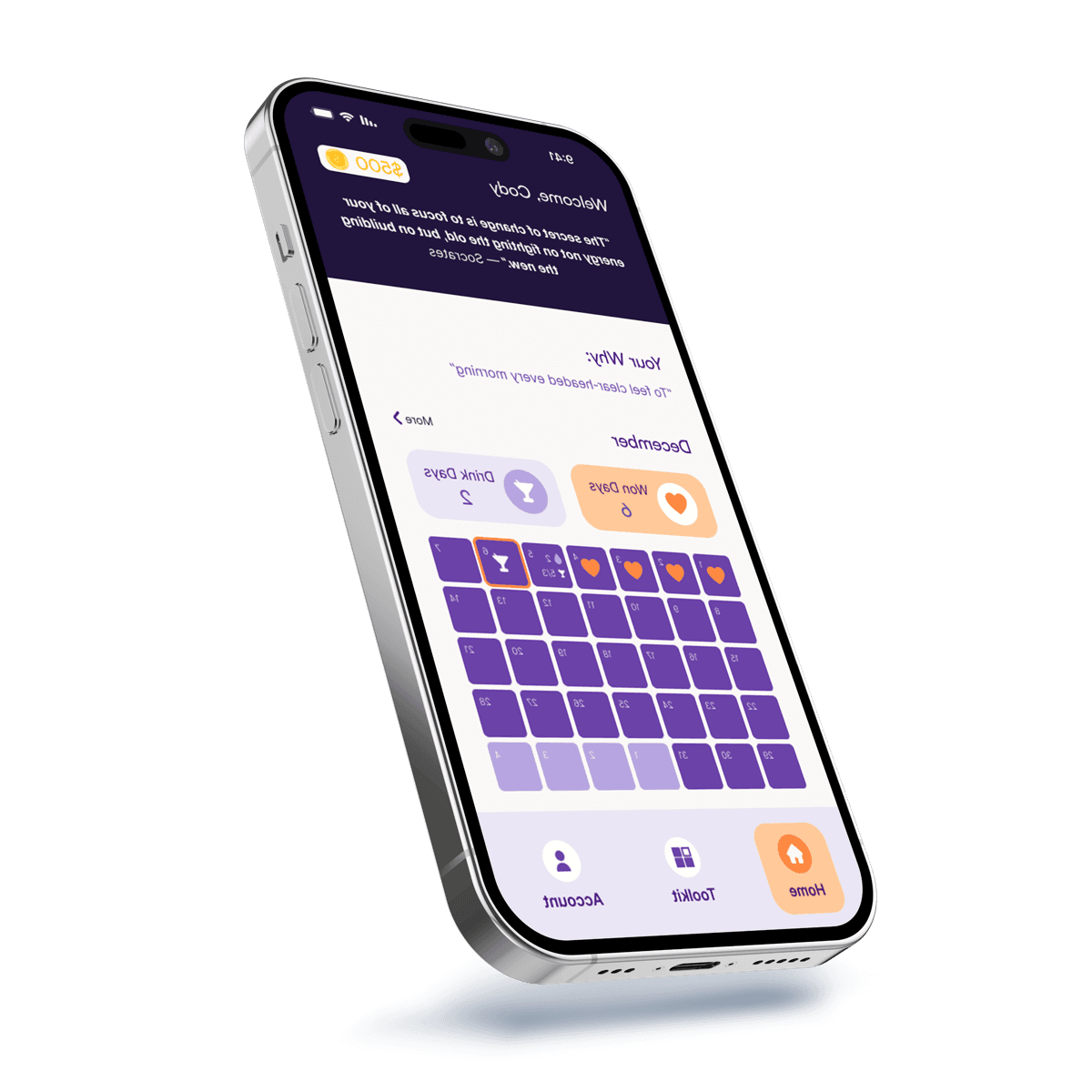
In Alcohol Reboot this is Your Why, and it's the first thing you write during onboarding for a reason: the limit is a number, and numbers are easy to argue with at 9pm. Your Why is the thing you're actually negotiating with.
A Limit Is a Ceiling, Not a Target
This one trips up nearly everyone, and it's worth being blunt about.
If your limit is ten drinks a week, you do not owe the week ten drinks. Finishing on six isn't leaving something on the table. There's no unused balance and nothing carries over. The limit is the maximum you've agreed not to cross, not a quota to fill.
Less is always better. Every drink you skip is progress on its own terms, whether or not it moves you past some threshold. A week of six against a limit of ten is a good week, full stop.
How to Actually Stick to It
Log Before You Drink, Not After
Small change, disproportionate effect. Logging afterwards is bookkeeping. Logging before you pour puts a two-second pause between deciding and doing, and you see the running total for the week while the decision is still open.
Sometimes you'll pour it anyway, which is fine. But seeing “seven of ten” before the eighth is a different experience than discovering it on Sunday.
Plan the Hard Nights While They're Still Far Away
You already know which nights this week will be difficult. The dinner, the birthday, the Friday that always runs long. Decide your number for those nights now, on a Monday, when the decision costs you nothing — because deciding in the moment means deciding while everyone's ordering another round.
Have a specific answer ready for what you're drinking instead. Soda water and lime, a decent non-alcoholic beer, whatever works. “I'll figure it out there” is how the limit gets spent by nine o'clock.
Check In Weekly, Not Nightly
Look at the week as a whole, once, for about five minutes. Nightly scrutiny turns a tracker into a nagging device and that's how people quit using them.
One week over your limit isn't a failure and it isn't a signal to start again from scratch. It's one data point in a trend. Look at the month, not the Tuesday.
When to Move the Number
A limit isn't permanent. Adjust it when the evidence says to.
Lower it when you've come in comfortably under for three or four weeks running. That's not luck, that's your new normal, and there's room to take another step down.
Raise it if you've been over every single week for a month. That sounds like surrender and it isn't. A limit you cross constantly stops functioning as a limit and becomes background noise you ignore. Better to set one slightly above where you are, actually hold it, and then walk it down — that's how a streak of steady weeks gets built in the first place.
And if you find that every limit turns into a nightly negotiation you're tired of having, it's worth asking honestly whether zero is what you're really after. Moderation isn't easier than stopping for everyone, and for some people it's harder.
FAQ
About a third below whatever you're currently drinking. There's no universal number, because someone at four a week and someone at twenty need different starting points. Yours should be based on your baseline, not on a figure from an article.
Weekly, for most people. A week is short enough that you can feel the total moving and long enough to absorb one big night. Monthly limits let you overspend for three weeks and then panic in the fourth.
Log it accurately and carry on. An honest record with a bad week in it is worth far more than a flattering one. The point of the tracker is to know what happened, not to look good in it.
Standard drinks: roughly a 12 oz beer at 5%, a 5 oz glass of wine, or a 1.5 oz shot of spirits. Home pours usually run larger than that, so a generous glass of wine is closer to two than one. Log it as what it actually was.
Usually three to four weeks. The first two are the hardest because you're breaking automatic patterns, not resisting temptation. Once the Tuesday drink stops being the default, holding the number takes much less effort than starting did.
If you're ready to find your baseline, Alcohol Reboot takes two taps to log a drink and shows you where your week stands against the limit you set. Two weeks of honest logging is all it takes to know what number you're actually working with. Available on the App Store and Google Play.